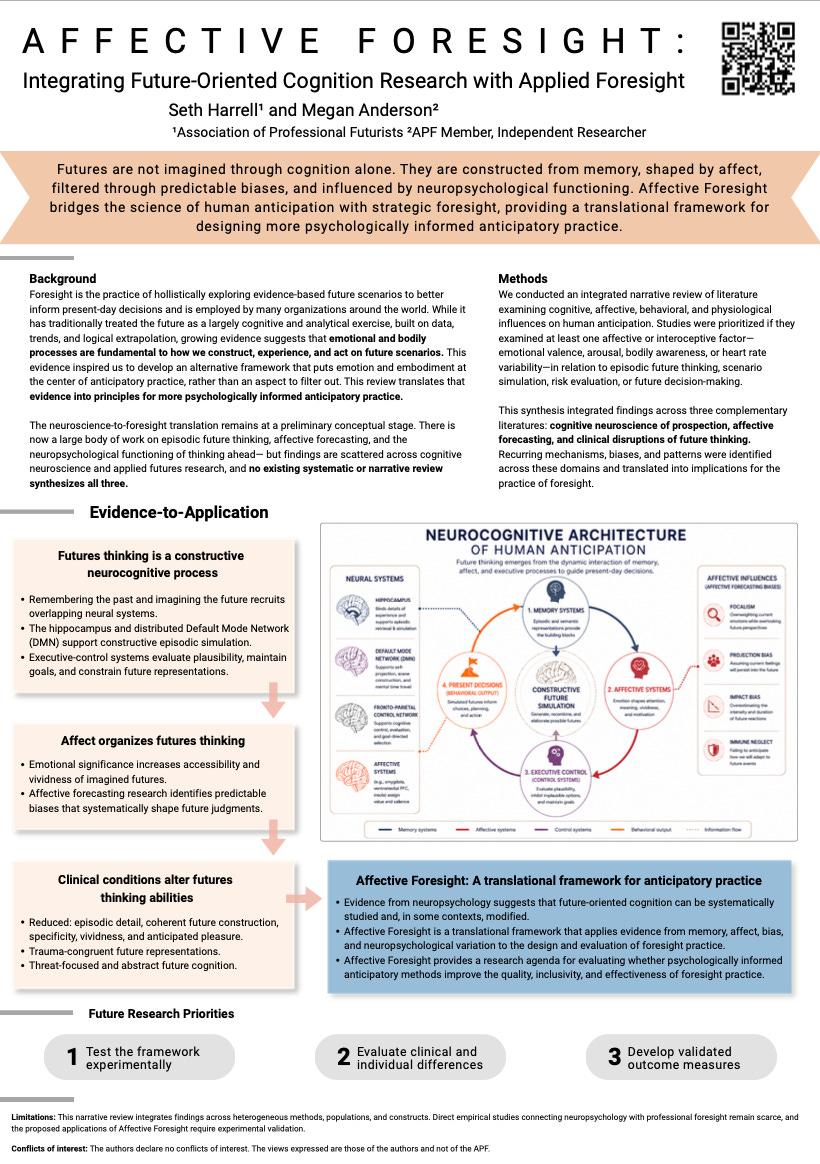
Earlier this year, Seth and I presented our work on Affective Foresight at the International Neuropsychological Society’s (INS) mid-year conference in Dublin.
Our presentation raises a question that sit at the heart of our work: What could research on how humans imagine the future teach us about the practice of foresight?
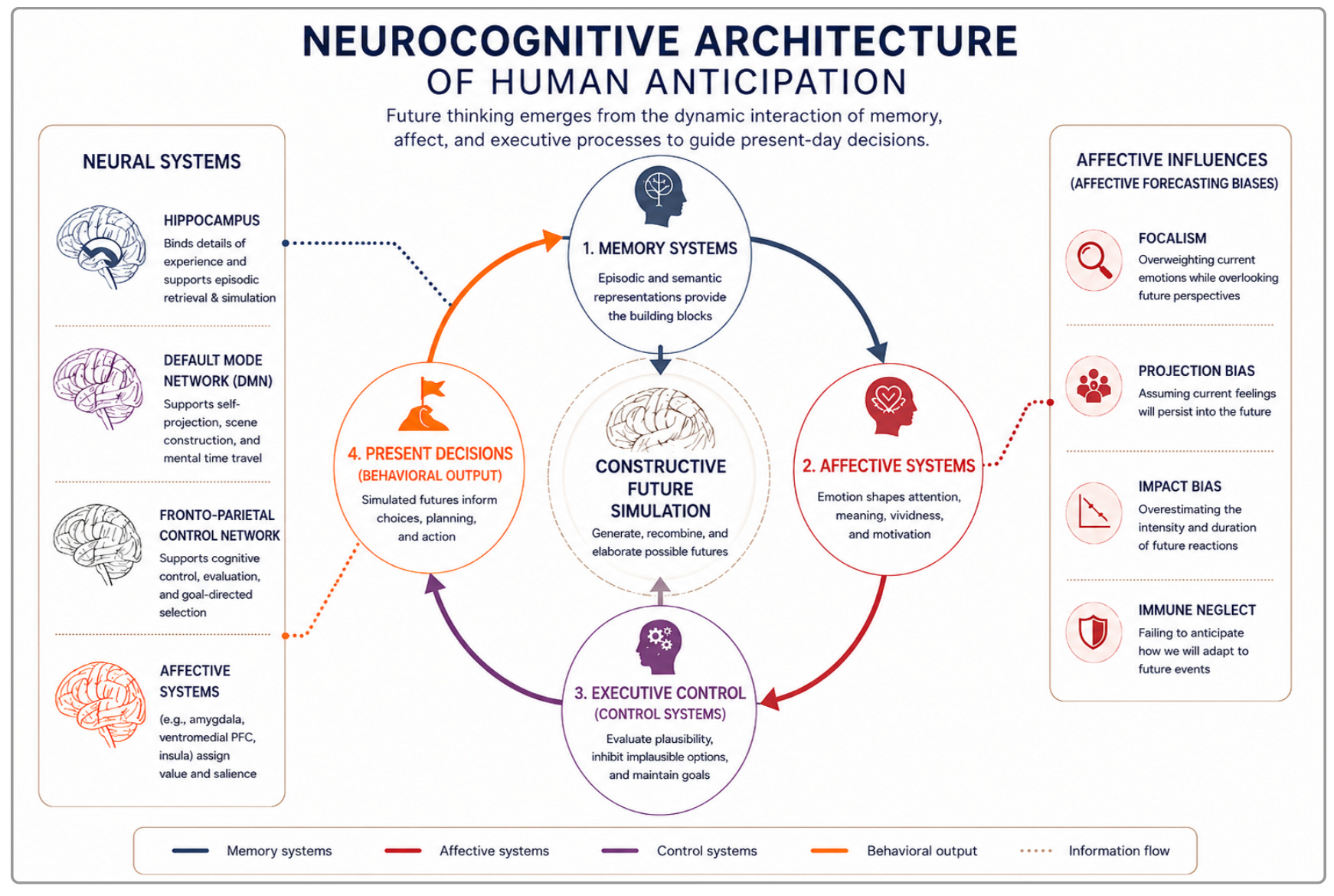
One of the clearest findings across the research is that future thinking is not a neutral process. When we imagine what might happen next, the brain draws on memory, recombines past experiences, evaluates possibilities, and constructs a representation of the future. Many of the same neural systems involved in remembering the past are also involved in imagining what comes next.
But cognition is only one part of a much larger story.
Emotion also helps shape which futures feel vivid, plausible, threatening, exciting, or worth acting on. Research on affective forecasting has also shown that people make predictable errors when anticipating how future events will make them feel.
Our hunch: this finding has important implications for foresight.
When participants respond strongly to a scenario, dismiss a plausible future, or struggle to imagine themselves in a particular future, those reactions are not necessarily noise to remove from the process. They may be part of the anticipatory process itself.
This led to the development of Affective Foresight as a translational framework that applies evidence from memory, affect, bias, and neuropsychological variation to the design and evaluation of foresight practice.
We are careful not to overstate where the research stands. Direct empirical research connecting neuropsychology and professional foresight is still limited, and the applications we are proposing need to be tested.
For us, that is what makes this work so interesting…it creates a research agenda around questions like:
How does emotion influence which futures people perceive as plausible?
How might known forecasting biases affect scenario work?
Do common foresight methods work differently across individuals?
How do we actually measure whether psychologically informed foresight produces better outcomes?
The core idea we brought to INS was this: futures are not imagined through cognition alone. They are constructed from memory, shaped by affect, filtered through predictable biases, and influenced by neuropsychological functioning.
If foresight depends on how humans imagine what comes next, then understanding the psychology of anticipation may be one of the field’s most important frontiers.
I’m sharing the full conference poster below for anyone who wants to dig a little deeper into the research behind these ideas. It includes the neurocognitive framework we developed, the evidence-to-application model, and the research priorities we think are most important to test next.
We’d love to hear what questions it raises for you—and where you see opportunities to connect this work more directly to foresight practice.
Stay tuned for upcoming blogs that take a closer look at each of the four parts of the framework.