
If You Want to Take the Future Seriously...You're Going to Need a Good Sense of Humor
The importance of humor to futures thinking

I have now had the opportunity to present about Affective Foresight twice. First, last year at the Futures of Creativity and Compassion APF x OCADU Nexus Event held in Toronto and most recently at the University of Houston Foresight Spring Gathering. In both of these presentations I included information about an aspect of Affective Foresight that is very important to futures thinking but often overlooked. The importance of humor and foresight from a historical, cultural, cognitive science, and horizon scanning perspectives…and their surprising overlap of skillsets. Over the next few months I will explore each one of these aspects in more depth, but here is a short overview to get you started!

Absurdity as a Cognitive Tool
“Any useful statement about the future should, at first, appear ridiculous.” - Jim Dator
As a practicing futurist, I could not begin without first citing futurist Jim Dator’s often quoted 2nd Law. This isn’t a throwaway provocation. It’s a precise description of how futures thinking actually works. A future scenario appears ridiculous precisely because it violates your current assumptions. The moment it stops seeming ridiculous is the moment you’ve updated those assumptions and you’re thinking more flexibly about what’s actually possible.
Comedic thinkers are practiced at stretching a premise to its furthest, most absurd extremes and this is exactly the cognitive muscle that futures thinking requires. Taking a current trend to its logical limit, asking what happens when it collides with another trend, imagining the human response to a world shaped by that collision. This is how both comedians find their punchlines and futurists find their scenarios. The goal isn’t to produce laughter. But looking for what’s funny in a future scenario will reliably reveal its hidden assumptions and its breaking points.
Bob Mankoff, longtime cartoon editor of The New Yorker, described humor as “the bringing together of two different things from different frames of reference that don’t normally go together, but here do go together.”
The Science Behind the Smile
The connection between humor and futures thinking isn’t just philosophical. Research shows that comedy activates multiple brain systems simultaneously. It reduces cortisol, the stress hormone that narrows cognitive flexibility and pushes us toward reactive, short-term thinking. At the same time, it triggers dopamine release, which enhances pattern recognition and rewards the brain for making creative connections. In other words, laughter chemically prepares the mind for exactly the kind of open, exploratory thinking that good futures work requires.
This matters because future uncertainty tends to produce the opposite effect. Anxiety and stress create cognitive paralysis — the brain locks down, conserves resources, and retreats to the familiar. Humor is, in this sense, an adaptive strategy. It transforms a threatening stimulus into something the brain can process safely, keeping the imagination mobile and willing to wander into uncomfortable territory.
Laughter as a Signal
Start with a simple but striking definition: laughter is an involuntary physiological and psychological response to perceived change. That framing immediately recontextualizes what laughter is and why it matters. We don’t laugh at things that are familiar, expected, or safe. We laugh at ruptures — moments when the world behaves differently than we anticipated. If that sounds familiar to futures thinkers, it should. Surprise is the currency of both comedy and foresight.
“Humor is based on surprise, and surprise is a milder way of saying shock.” - George Carlin
A comedian’s job is to set up a premise with expected expectations and then deliver a surprise to produce laughter. A futurist’s job is remarkably similar: to produce surprise for the sake of preparing people for threats and opportunities they haven’t yet imagined. The comedian wants you to laugh. The futurist wants you to think. But both are in the business of making the expected suddenly feel strange.
Benign Violation: The Theory That Explains the Joke
The most current scientific framework for understanding why things are funny comes from the Humor Research Lab (HuRL) at the University of Colorado. Their Benign Violation Theory proposes that humor occurs when three conditions are simultaneously met:
Something seems wrong, threatening, or uncomfortable (a violation)
That violation feels safe or acceptable (benign)
Both perceptions occur at the same time.

The theory is elegant because it explains the dynamics that comedy and futures must navigate. A scenario that is purely threatening produces anxiety, not insight. A scenario that is entirely safe produces nothing at all. The productive space is the one that feels both wrong and okay at the same time by violating your assumptions but not overwhelming your ability to engage with it. This is the psychological sweet spot where productive futures-thinking happens.
Futures practitioners who have struggled to get colleagues to engage genuinely with uncomfortable scenarios will recognize this problem immediately. The Benign Violation framework suggests that framing provocative futures with a degree of humor isn’t softening the message, it’s making the message receivable.
The Trickster Tradition
Humor’s relationship to truth-telling and social change has deep historical roots. Court jesters were, by the nature of their role, the only figures permitted to speak uncomfortable truths to people in power. By making fun of anyone and satirizing social customs, jesters were often catalysts for social change. Futurist Wendy Schultz has encouraged practitioners to “embrace the trickster spirit,” a tradition carried forward through cultural mythological figures, whose disruption of order always reveals something the orderly world could not see.
Comedians occupy a similarly liminal space. They never quite fit into the culture they’re observing, which gives them the freedom to see it from the outside. As one framing from the research puts it, comedians exist in transitional spaces that allow them to separate from the world around them. This outsider perspective is also what makes a good futurist. The best futures thinking, like the best comedy, requires you to see your own assumptions as assumptions.
Comedy Knows the Culture
Larry Charles, traveling through some of the world’s most volatile regions to study local comedy, concluded: by knowing a country’s comedy, you will know its past, present, and future. Humor plays off the shared unspoken assumptions that define a culture. To find something funny, you have to know the rule that’s being broken. And once you know where the rules are, you can step outside them.

This is why humor is such a valuable tool for horizon scanning. The jokes a culture tells reveal what it takes for granted and what it hasn’t prepared for. A comedian who finds a new source of laughter is often identifying a new social tension, a shifting norm, or an emerging contradiction that hasn’t yet made its way into mainstream analysis. If you hear laughter, you know surprise has been achieved. Then it’s time to evaluate plausibility.
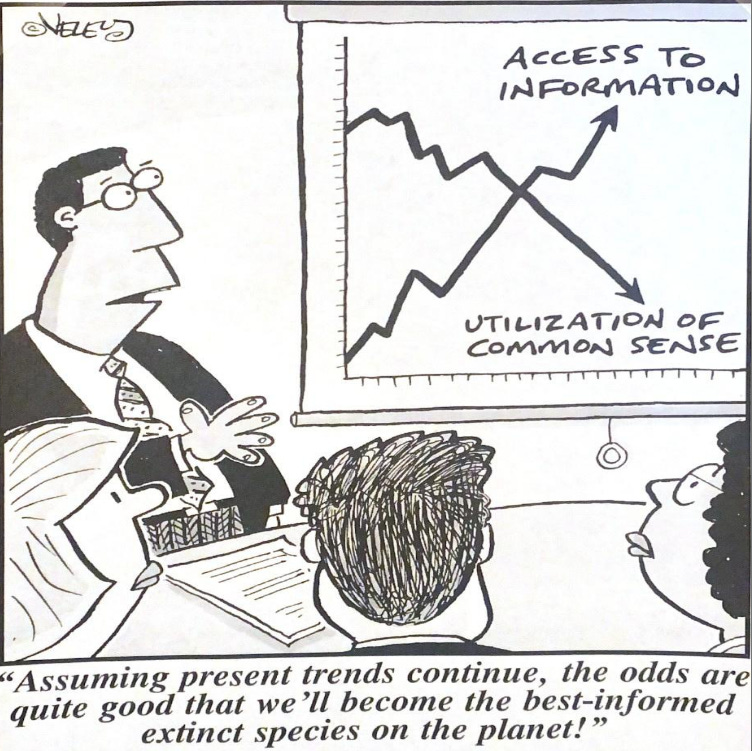
Every ridiculous future was once someone’s logical trend projection. The future is serious business, and seriousness without flexibility produces anxiety, not insight. Humor loosens the cognitive machinery, lowers the emotional stakes, and makes space for the kind of imaginative leaps that genuine foresight requires. The question isn’t whether to laugh, it’s whether you’re paying attention to what the laughter is telling you!