

I picked up David McRaney’s How Minds Change expecting a book about persuasion. What I got instead was a book about feelings, which is exactly the kind of accident that keeps happening to me since I started working on Affective Foresight.
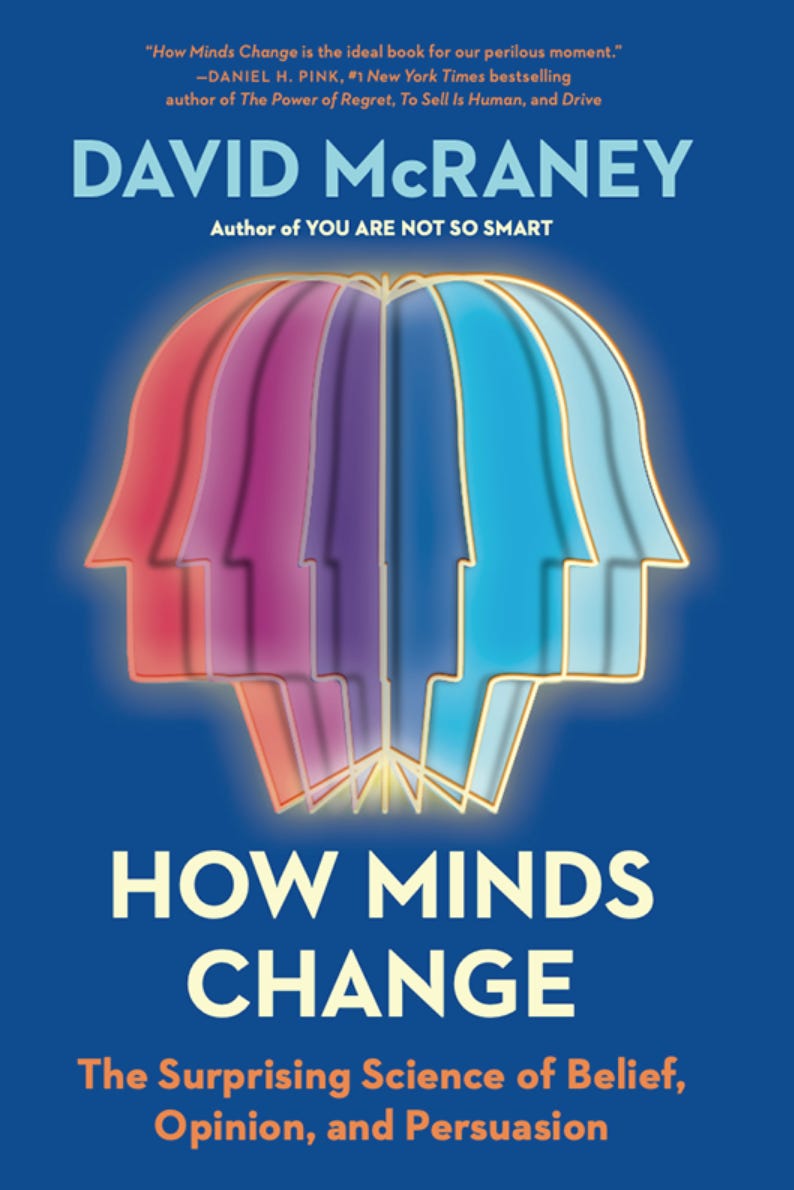
McRaney spends most of the book following people who do the hardest version of belief change for a living. Deep canvassers who flip votes on gay marriage in a single twenty minute conversation. Street epistemologists who talk flat earthers out of flat earth at their own convention. Cult members who walk away after decades. What ties all of it together is that none of them win the argument by winning the argument. They win by getting someone to feel safe enough to update. That single idea rearranged how I think about foresight work.
The model you don’t know you’re running
There’s the concept from the book that I can’t stop thinking about which he calls the assumptive world. It’s the running model every one of us carries about how reality works, what we can expect from it, and where we stand in it. It’s not a stack of opinions you could list off if asked. It’s the thing opinions are built on top of, and it feels less like a belief and more like plain fact.
That model does three jobs. It puts whatever is happening to you right now into context. It runs constant if-then predictions such as “if I do this, then that will follow.” It is a social construction that tells you how to behave so you don’t fall out of favor with your tribe or lose your social footing.
That description sounds like the description of an affective forecast. When I ask a room full of executives how they’ll feel about a future scenario, I’m not asking them to consult some feeling that already exists out there waiting to be reported. I’m asking their assumptive world to run an if-then, filtered through today, and hand back an answer their peers would find acceptable. That’s why so many affective forecasts are just the present wearing a costume. They aren’t projections of the future as much as the current system protecting itself.
This is the piece I think Affective Foresight has been circling without quite naming. We keep saying people are bad at predicting how they’ll feel about the future. McRaney’s book gave me the mechanism. They’re not bad at it. They’re using a tool that was built for a completely different job, and it’s doing that job perfectly.
Why the big dramatic scenario backfires
There’s a researcher named David Redlawsk who found something that should be known to every futurist. When you hit someone with information that contradicts what they believe, they don’t soften. They dig in harder. Motivated reasoning kicks up a notch, and they get more committed, not less.
But only up to a point. Redlawsk found a threshold where the anxiety of continuing to defend the model finally outweighs the effort of revising it, and the person actually flips. In his research it landed somewhere around thirty percent of the incoming information being incongruent. Belief change isn’t represented by a gradual sloped graph. It’s a punctuated equilibrium.
I’ve watched this happen in workshops without having a name for it. You put one shocking scenario in front of a room and you get a wall of polite reasons why it can’t happen. The timeline gets pushed past everyone’s retirement. The implications get nodded at and then quietly shelved. It looks like failure, and facilitators often read it as failure, and they back off right at the moment the equilibrium was nearly punctuated. The lesson I’m taking from this is that intensity and repetition could matter more than the shock value of a scenario, and the feeling of a good workshop landing might actually be the feeling right before people flip.

Why the room never agrees…and why that’s a good thing
There’s a model in the book called SURFPAD, which came out of research on things like The Dress, that photo where half the internet saw white and gold and the other half saw blue and black. Substantial uncertainty plus forked priors equals disagreement. When something is genuinely ambiguous, your brain fills the gap with whatever history it’s carrying, and when two people’s histories have forked, they aren’t just interpreting the same thing differently. They’re perceiving different things, and each one is certain the other is being ridiculous.

A scenario is an ambiguous stimulus on purpose. That’s the whole point of scenario work. So when two people in a room react to the same future with dread and with excitement, they aren’t malfunctioning. They’re showing you their priors in real time, which is some of the richest information a workshop can produce. Some facilitators may treat that disagreement as noise to smooth over on the way to consensus. I think it’s the opposite. It’s the data.
The error in thinking that accompanies this is what Lee Ross called naive realism, the quiet conviction that you see things as they actually are, and that anyone reasonable would land where you’ve landed. It’s the assumption that makes someone else’s different reaction feel like a moral failure on their part instead of a legitimate output of a different history. It’s also the belief that’s hardest to see in yourself, which is a little humbling to admit as someone who designs the rooms where this plays out.
The hopeful part
The growth doesn’t come from the trauma itself. It comes from the rebuilding the trauma created.
The chapter that stuck with me longest wasn’t about arguing at all. It was about post traumatic growth, the finding from Tedeschi and Calhoun that a real share of people who survive something that shatters their assumptive world come out the other side with more than recovery. Reordered priorities. Deeper relationships. A wider sense of what’s possible.
That leaves me with the question I actually care about answering with this work:
If the deepest belief change usually only shows up after real catastrophe, can a well built anticipatory experience get people close enough to that same rebuilding, on purpose, without requiring the wound first?
Not that we can make people feel the future perfectly, just that we can build a room safe enough for their model to bend a little before life forces it to break.
Love this!